
Why Waiting for Your MRI Might Be the Biggest Mistake You Make for Your Hip Pain

If you’re dealing with hip pain and wondering, “Do I need an MRI for hip pain before I start treatment?” — you’re not alone. So I need you to hear this with love:
Waiting might be the very thing keeping you stuck.
And I know that might sound bold, espeically when you want answers, clarity, and to know what’s actually happening inside your hip before you start doing anything.
But here’s the part no one explains…
An MRI is just one tiny piece of the puzzle.
And in many cases, it’s not the piece that determines your healing timeline.
The 6–8 Week Waiting Trap No One Talks About
Let’s walk through what typically happens.
You feel hip pain.
You wait to get the visit with ortho.
Then you wait to get the visit for the MRI.
Then you wait for results.
Then you wait for your follow-up.
Then maybe you wait for a PT referral and your first session.
Suddenly… 4–8 weeks have passed. And in that time:
Your pain hasn’t improved.
You’ve started guarding and compensating.
You’re spiraling on Google at 2am.
You’re wondering if this is “just your new normal.”
Here’s the hard truth:
Waiting is a decision.
And often, it’s the decision that keeps pain lingering longer than it needs to.
What a MRI Actually Shows (And What It Completely Misses)
This is important for you to understand.
An MRI shows structure. Things like:
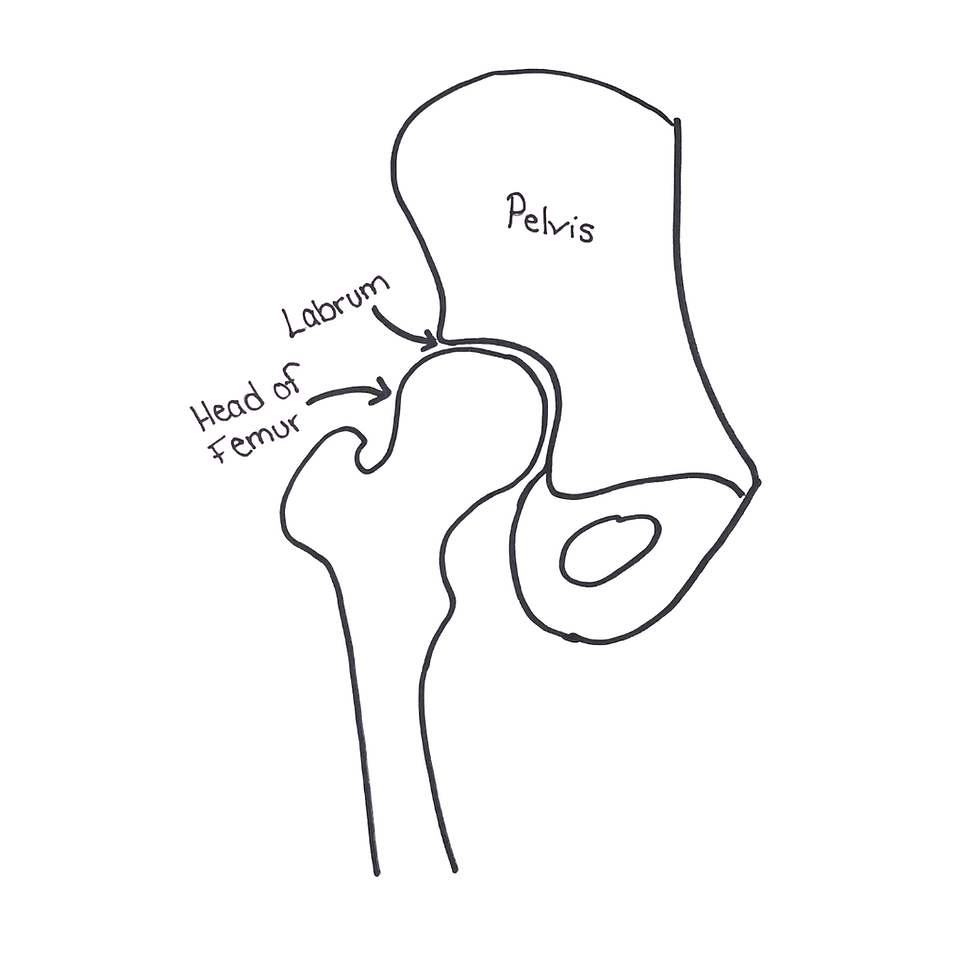
Labral tears
Structual femoroacetabular impingement (FAI)
Arthritis
Fractures
But it does not show:
How you move
Your muscle imbalances
Your stability under load
Your nervous system sensitivity
Your stress levels
Your movement habits
Your load tolerance
FUNCTIONAL hip impingement
And guess what?
Those are often the drivers of persistent hip pain. Not the structural problems.
You can have a labral tear and feel no pain. You can have arthritis and function normally. You can have “degeneration” and still dance, lift, run, and live fully.
Studies consistently show that 60–70% of people with zero symptoms still have positive findings on MRI. Let that sink in.
If there is one thing I want you to take away, it's that structure does not automatically equal pain.
The Dangerous Story We Create From Imaging
This is the part that really gets to me as a PT...
When you open your MRI report you see words like:
“Degenerative changes”
“Impingement”
“Tear”
“Arthritic findings”
No one translates it clearly. No one explains what’s normal for your age. No one tells you how common these findings are.
So your brain fills in the blanks.
You start thinking:
“I’m broken.”
“I’m too young for this.”
“This will only get worse.”
“Surgery is inevitable.”
But here’s the truth:
Your MRI does not get to decide your future.
And especially for women like you — active, strong, body-aware, used to moving — imaging often becomes more scary than helpful when it’s not interpreted in context. And the stories we end up telling ourselves are not always reality.
So next time you open your imaging results, don't spiral. Find someone who can interpret them in a meaningful way and then give you a clear strategy forward. That is what creates momentum instead of fear.
Why You Can (And Often Should) Start Rehab Before Imaging
Physical therapists are trained to injuries from the outside. We look at things like strength, range of motion, movement patterns, load tolerance, and symptom behavior and are able to interpret that into "results."
Do we have X-ray vision? No
But we are really good at gathering an incredible amount of information just from how you move and how your pain behaves.
And here’s the key:
There is almost always something safe you can start immediately.
That may look like gentle mobilty work, breathing, manual therapy or movement education. It may mean having a conversation about what you can/can't do and how to modify your movements to provoke less pain. Sometimes it’s as simple as diaphragmatic breathing to calm your nervous system.
Either way, we don't always need a picture to tell us where to start.
When Is an MRI Necessary for Hip Pain?
Let’s be clear — I am not anti-MRI.
Imaging is extremely important for many things like:
There was trauma (fall, accident, major impact)
We suspect a fracture
There are red flag symptoms
You’ve done quality rehab and nothing is changing
Symptoms are worsening despite proper intervention
But that’s different from automatically waiting before doing anything.
Strategic imaging? Yes. Default waiting? Not always helpful.
The Momentum Factor: Movement vs. Stagnation
Pain thrives in stagnation.
The longer you wait:
The more compensations develop
The more fear builds
The more the nervous system amplifies the signal
The more your identity starts wrapping around “chronic pain”
Movement, on the other hand, builds momentum.
And even small, strategic movement shifts can:
Reduce inflammation
Improve joint mechanics
Calm the nervous system
Restore confidence
Show you your body is not broken
That psychological shift alone is powerful.
I hope you are reading this
If you’ve felt dismissed…
If you’ve been told “you’re too young for this much pain”…
If you’ve bounced between providers and still don’t feel clear…
I want you to know this:
You are not being dramatic. You are not weak. And you are absolutely not doomed.
But waiting passively for an image to tell you what to do next?
That might not be the strategy your body needs.
What to Do Instead
Instead of waiting, consider this:
Get evaluated by someone who understands hip mechanics deeply.
Start safe, strategic movement now.
Use imaging as a tool — not a verdict.
Let progress guide decisions, not fear.
In many cases, women begin seeing meaningful changes within 4 weeks of focused, personalized rehab.
And sometimes? Pain resolves enough that the MRI becomes unnecessary.
Ready to Stop Waiting?
At On Pointe Wellness and Rehab, we specialize in helping women like you navigate hip pain with clarity, confidence, and a plan.
We don’t ignore imaging. But we also don’t let it define you.
If you’re tired of waiting…If you’re tired of guessing…If you’re ready to actually understand what your hip needs…
Book a discovery call with one of our therapists today.
Let’s look at your movement. Let’s look at your story. Let’s build a strategy that makes sense.
Because movement creates momentum.
And you deserve to start now.


Comments