
Why Stretching Isn’t Helping Your Hip Pain (And What To Do Instead)
- Jenna Loewer
- May 26
- 6 min read
You stretch. You foam roll. You dig a lacrosse ball into your hip for an hour…
And maybe you get a little relief, except it only lasts 10 minutes. Because as soon as you stand up and go about your day, it feels like everything just locks right back up on you.
Sound familiar??
If this is the cycle you keep getting stuck in, here's what nobody's telling you:
If stretching isn’t helping your hip pain… it’s probably not a flexibility problem.
When stretching is helpful
Let’s just give a little disclaimer here that stretching may be the correct next step for some of you. If your muscle truly is shortened, then stretching it can really help your imbalances and and symptoms. But they key here is, you have to first figure out if muscle length is really the problem. This is where working with a skilled Physio can make all the difference, because they will be able to check muscle length and determine which type of movements are best suited for your specific issues.
So now that we got that out of the way, let’s talk about those of you who have been stretching and it isn’t helping at all.
Why You Feel Tight (Even If You’re Already Flexible)
This is the thing most people don't realize: just because something feels tight doesn't mean the muscle is physically short or inflexible. Sometimes it's a sign of something much deeper.
If you're doing all the stretching, all the foam rolling, and nothing is changing long-term, that tells us muscle length isn't your biggest issue.
What we then need to look at is your neuromuscular system. This is what connects your brain to your muscles. Your brain's job is to protect your body, so when it perceives something as a threat — even something like a squat that causes a pinch — it responds the same way it would if you were being chased by a bear. Tensing. Guarding. Protecting.
In the short term, this is pretty helpful. For instance, if you sprain your ankle, your body tenses those muscles so you don't roll it again. Smart system, right? But if that response goes on too long, what was once protective starts to becomes problematic. And it’s exactly why you can stretch for 20 minutes, yet feel just as tight as when you started.
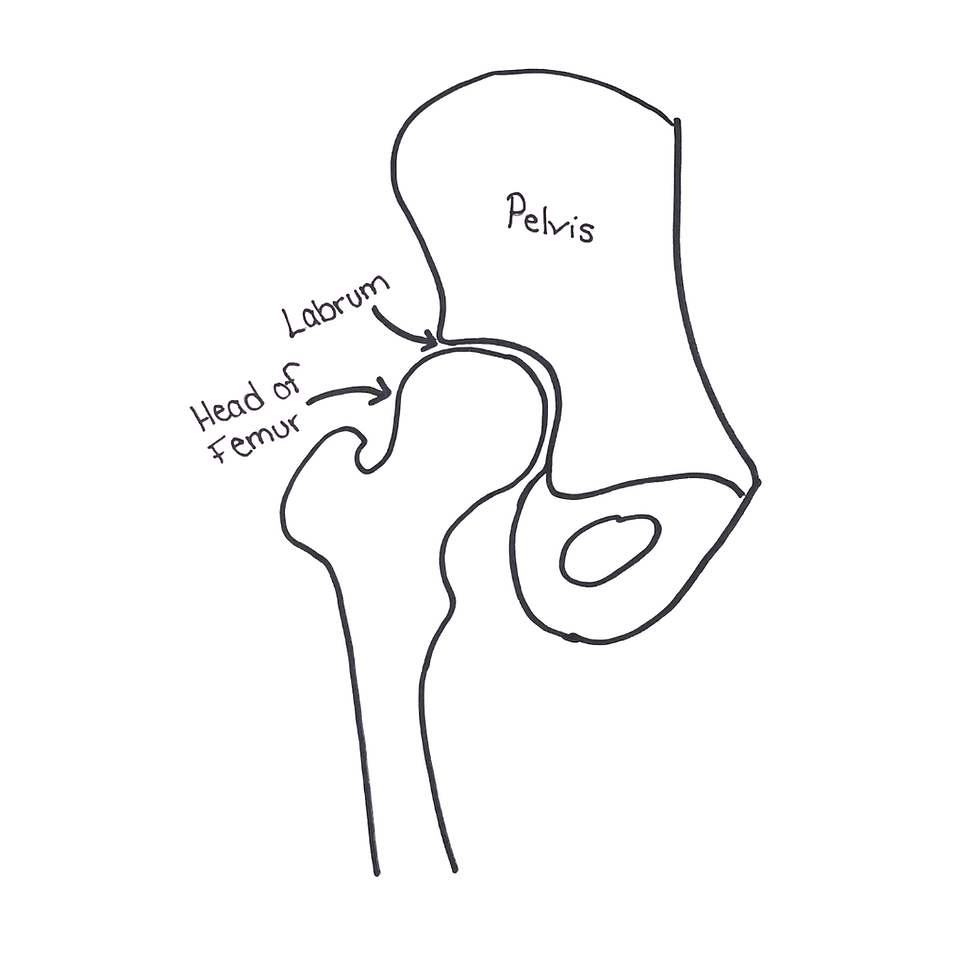
This is especially common if you've been dealing with the pain from labral tears or impingement for a while. The longer the pain has been going on, the more ingrained those patterns get. You can still change them; it just takes more time and repetition. So that tension you're feeling every day despite all the stretching in the world? There’s a good chance it’s your nervous system running a protection program that your body doesn't actually need anymore.
Stretching Can Actually Make Things Worse
When your nervous system is in protection mode, that tension is intentional… basically your body created it on purpose. So, if you aggressively stretch, it can make things worse.
Why? Because when you push into a stretch or range of motion that your body doesn’t feel safe in, it triggers the nervous system into a fight or flight response, which equals even more protecting and muscle guarding.
Stretching shouldn’t be a "no pain, no gain" approach. You must instead learn how to work with your body, not fight against it.
For a lot of clients I work with, stretching doesn't just fail to help. It actually makes them feel worse. Stretch can take away the joint's sense of stability, which your nervous system may not like. This is especially true for those of you who may also be dealing with hypermobility (but we’ll save that discussion for another day).
What Helps More than Stretching
If the nervous system is creating the tension, then the nervous system is what we need to address. Here are three places to start:
1. Diaphragmatic Breathing
If you don't know where to start, start here. Diaphragmatic breathing is one of the most powerful ways to calm your system down — it helps release the tension your muscles are holding, regulates stress, and stimulates the vagus nerve, which helps bring your nervous system back online.
Stress can be a direct trigger for pain. Breathing helps kills two birds with one stone — you're addressing the stress and the pain that comes from a dysregulated nervous system.
Box breathing is a great starting point: inhale 4 seconds, hold 4, exhale 4, hold 4. Simple, easy, and it works.
*One thing I want to flag specifically for my hip people: a lot of folks are familiar with diaphragmatic breathing but aren't actually doing it correctly — and the piece that tends to get missed is lengthening through the pelvic floor. That matters because the pelvic floor is part of the hip system. It's where a lot of that guarding and tension lives. If you're not finding length there, the breathing won't be as effective as it could be.
2. Mindfulness and Meditation
This goes hand-in-hand with breathing, but for some people, focusing on the mechanics of diaphragmatic breathing can feel really hard at first. If that's you, start with a simple meditation instead.
I can't count how many times I've had a patient come in so flared up, so stressed, nervous system completely on overdrive and nothing is working. When this happens, I'll shut off the lights, we’ll lay down on yoga mats, and just meditate as part of the session.
Almost every single time, their immediate response is: "I feel so much better." And not just mentally — their pain actually decreases as well. Why? Because if the nervous system dysregulation is driving the pain, you have to address the root cause. Sometimes the most powerful thing you can do is slow down and let your body melt away some of that tension.
3. Build Awareness of Where You're Holding Tension
Let me ask you something… are your glutes clenched right now?? If you are struggling with hip pain right now, I’d bet money on it that you were until you read that ;-)
Many people with FAI or labral tears have developed a habit of squeezing their glutes 24/7 without even realizing it. Often, the reason this happens is because of a lack of stability in the hip joint. So the muscles tense to either a.) protect, or b.) create a better sense of stability.
If you’re not addressing where the tension is coming from, stretching alone is likely not going to change it. The second you stop stretching and go right back to moving with the same habits and patterns as before, the tension comes right back.
So I’d challenge you to start noticing. Are you clenching while you sit? While you drive? While you're just standing there? You'll start to catch the patterns of when it tends to happen, what triggers it. Once you're more aware, you can actually start to make long-term changes instead of quick fixes.
Full disclosure- This is hard at first, especially if you're used to being constantly tense. But I do promise that it gets much easier. Build the awareness first, and the rest will follow.
The Trust Bank
If your body doesn't trust movement, it will keep protecting you with tension. The only way out of that is to gradually reintroduce the things that used to trigger a flare — squats, lunges, loading — in a way that feels safe. Not so much that your body panics, but enough that it actually has to adapt.
Every time you do that, you're depositing a coin in your trust bank.
Here’s what that looks like: You did the squat. Nothing bad happened. Your brain learns, “hey, that wasn’t so bad after all.” And over time, that squat that used to cause a pinch doesn't cause anything anymore.
Over time, that trust bank gets fuller and fuller, and now you can start strength training without it making you flare every time.
It's a delicate balance — challenging yourself without pushing so far that you create that big protective flare-up again. But the more you practice and bring awareness to it, the easier it gets.
The Bottom Line
If you're constantly stretching or foam rolling, and nothing is changing (or things are getting worse), more flexibility probably isn't what your body needs. It’s time to stop wasting your energy on strategies that don’t work, and instead learn to listen to what your body is asking for.
The three places to start: breathing, meditation, and releasing that chronic glute and pelvic floor tension by actually building awareness of when you're holding it.
These things are simple, but that doesn’t mean they are easy. These patterns are likely deeply ingrained, but they are absolutely still able to be changed.
Ready to Figure Out What's Actually Going On?
If you're tired of the cycle — constant tightness, stretching every day, nothing sticking — you don't have to keep trying to figure this out on your own.
The Physical Therapists at OPW are trained to help you better understand what your body is actually telling you, calm the nervous system, build real stability, and get back to moving without fear.
👉 Book your free discovery call here and let’s figure out what’s really going on in your body—and how to fix it for good.


Comments