
Treating Hip Impingement And Labral Tears Without Surgery: What Actually Works When Nothing Else Has
If you've been endlessly researching how to treat hip impingement and labral tears without surgery, you just landed in the right place. You’ve likely already tried all the things and are stuck in one of two places right now:
Either you've quietly decided this pain is just something you have to live with forever and that the things you used to love doing are off the table now.
OR you're starting to think surgery might be your only option left… except you're not even confident that's the right call for you.
I want you to hear this clearly: both of those options suck and neither has to be true. There is another path, and I've spent the last 13 years building it with hundreds of clients who came to me exactly where you are right now.
What Hip Impingement Actually Is
Let's do a quick anatomy lesson, because I know how frustrating it can be to keep guessing at what's happening in your own body.
Your hip is a ball-and-socket joint — the femoral head (the top of your thigh bone) sits inside the acetabulum, which is the socket on your pelvis. When that relationship gets a little off, you get femoroacetabular impingement (FAI).
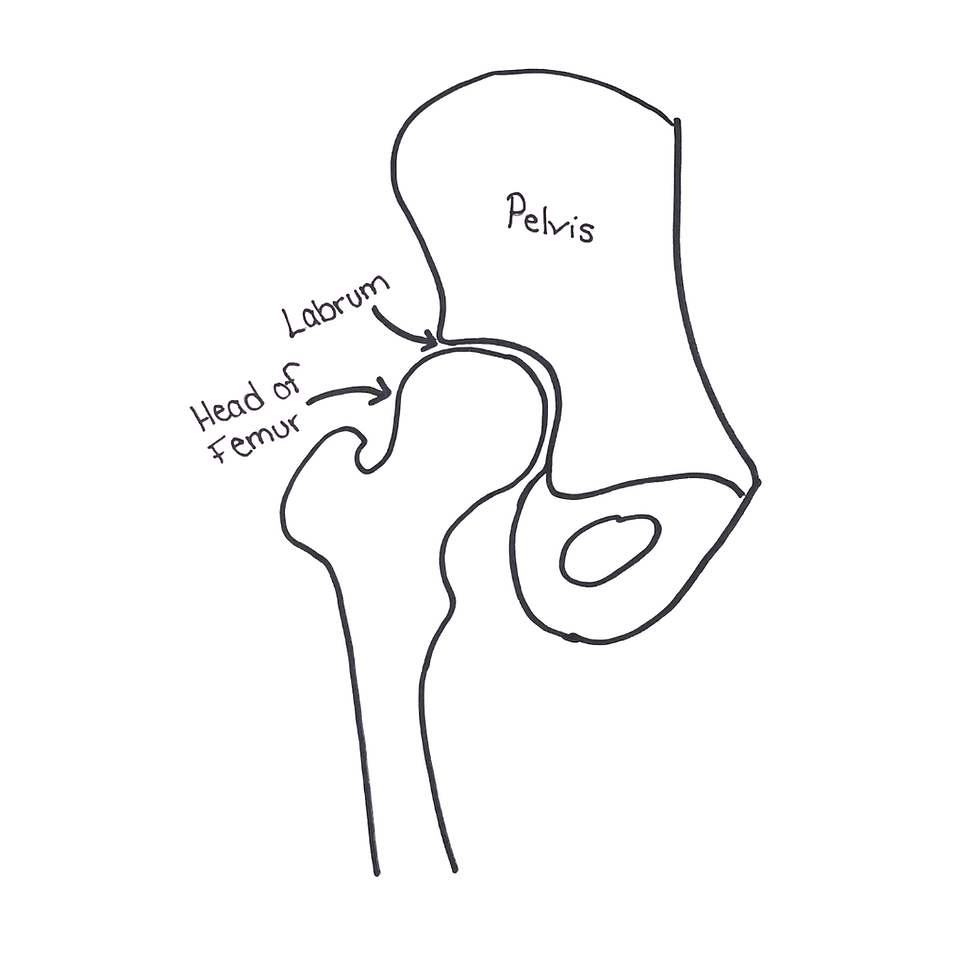
The labrum is the ring of cartilage between the two bones. Its job is to cushion and deepen the socket, keeping the femoral head stable while still letting you move freely.
There are 2 types of “structural impingement”:
Pincer impingement means there's extra bony growth on the socket side.
Cam impingement means the extra growth is on the femoral head.
You can have a combo of both

Either way, the head doesn't sit in the socket quite right, and movement starts creating compression and irritation where it shouldn't.
Here's the part that gets left out of almost every conversation about this, though:
It's very rarely just a structural problem. More often, it's also a movement problem — and for some people, it's purely a movement problem.
If the muscles around your joint aren't stabilizing well and you're not moving with good patterns, the head of the femur drifts too far forward in the socket and it catches on the labrum. That repetitive catching and pressure over time (usually with movements like bringing your knee towards your chest, sitting too long, or squatting) is often what causes fraying and eventually tears.

In other words, its extremely important to correct the movement piece. Because even if you address structure with something like surgery, it doesn’t change HOW you move and the problem is really likely to come back.
The Symptoms Aren't as Random as They Feel
If you are struggling with impingement or tears, I know it can seem like your hip has a mind of its own. But there's almost always a pattern to your symptoms, even when it doesn't feel that way.
The most common signs I see with hip impingement and labral tears:
🔹 Pinching or sharp pain in the front of the hip or groin (though pain can also show up on the outside, the back, or the SI joint)
🔹 Catching, clicking, or popping
🔹 The "C-sign" — a deep, hard-to-pinpoint ache that wraps around the hip in the shape of a C
🔹 Hip flexor tightness that never seems to go away no matter how much you stretch (and sometimes stretching makes it worse)
🔹 Pain that migrates — to the back, the knee, or even your "good" hip from compensating
🔹 Pelvic floor symptoms like leaking or pressure/heaviness, since the pelvic floor shares a lot of the same muscles as your hip
If a few of these are hitting close to home, I want you to know something before we go any further: this is not your fault and there is most definitely something you can do about it.
Why Hasn't Anything Worked for your impingement or labral tear So Far?
If you've done the PT, the stretching, maybe even the injections or surgery, and you're still stuck — you sound like about 99% of the people I've worked with over the last 13 years.
Here's the biggest reason I see people stay stuck: traditional physical therapy does a pretty bad job of actually teaching you how to understand your hip.
So what does understanding your hip really look like? It’s knowing what's triggering your pain. How to calm a flare-up if it happens. What "moving with good patterns" actually means for your body specifically.
Your problem was never a lack of effort. You've done the things. What you haven't had is a clear strategy.
A few example of common mistakes that can keep you stuck are:
Strengthening gets layered on top of a bad movement pattern — which just reinforces the dysfunction instead of fixing it
The nervous system side gets ignored entirely, even though a guarded, stressed system will sabotage your progress every time
Treatment becomes a guessing game — random exercises thrown at the wall because nothing was ever built around your specific body
Physical therapy, as a field, trains generalists. Great at treating a lot of things reasonably well. Not always great at treating your very specific hip issue, because there's a specific pathway to get you unstuck — and most clinicians simply aren't looking for it.
Do You Actually Need Surgery for a labral tear?
This is the question I get asked more than almost anything else. If there's a structural problem, shouldn't the structure need to change?
Sometimes. Not always.
Here's a stat that surprises most people: a large number of people with zero symptoms still have a structural impingement or a labral tear show up on their imaging. So the real question isn't "is there a structural finding" — it's "is that structural finding actually what's creating your pain and dysfunction."
Surgery will absolutely fix the structure. It can shave the bone, repair the labrum. What it can't do is change how you're moving. And the people who tend to struggle most after surgery are usually the ones who went in without ever addressing that piece — expecting the surgery alone to solve a problem that was always partly mechanical to begin with.
For some people, surgery is still the right call. But it should be the last resort, after you've genuinely exhausted conservative care done the right way. If you're on the fence, do the work first. Worst case, you still end up needing surgery — except now you go in stronger and recover faster. Best case, you delay or avoid it altogether.
Either way, the work you put in beforehand is never wasted.
The Framework I Use to Treat Hip Impingement and labral tears Without Surgery
This didn't come out of thin air. It came from over a decade of specializing in exactly this, watching what actually moves the needle when everything else has failed. I call it the CORE framework, and it's the same process I use with every single one of my clients.
C — Calm & Understand. Before anything else, we lower the reactivity of your hip — the pain, the clicking, the tension — by building real understanding of what's happening in your body and identifying your specific patterns. One of the biggest mistakes I see is jumping straight into strengthening while the joint is still flared and defensive. That just sets up the cycle: flare, rest, restrengthen, flare again. Instead, we have to get it to calm down AND come up with a plan for you to confidently manage your flare ups when they happen.
O — Optimized Movement. Once things are calm, we reduce joint stress by correcting movement patterns. There are common imbalances I see across almost everyone with impingement or tears, but the specifics are always individual to you. Strengthening on top of a dysfunctional pattern just reinforces it — so we lay the movement foundation first, then build on it.
R — Rebuilding Strength. With the joint calm and the movement pattern solid, it’s time to start loading it. Most traditional rehab jumps straight to this part, and strengthening without a solid foundation only leads to plateaus and frustration. But if you’ve built a foundation of good movement FIRST, strength will actually make you feel better instead of worse. This phase is all about progressive overload done safely, so you build real resilience for the long haul.
E — Elevate Performance. We never stop at "the pain is gone" or "I got a little stronger." This phase brings your hip back into the real demands of your life — running, hiking, dancing, chasing your kids — so the change actually holds up long term instead of unraveling the first time life gets demanding. It also is where we create a realistic and sustainable plan for the future (because who wants to be stuck doing PT forever?).
These phases aren't rigid. You can move forward and back as needed. But the strategy stays the same… and that’s what finally gets people unstuck.
If you want to learn more about the CORE framework, I’ve wrote all about it in my book “Hip Impingement to Hope.” You can grab your copy here.
Where Are You Right Now?
Take a second and think about where you'd place yourself: still trying to understand what's going on (that's completely normal, and it's exactly where this article is meant to meet you), working on calming things down, rebuilding your movement patterns, layering in strength, or already back to the things you love and just working on making it stick?
Once you are aware of where you might be getting stuck, it’s a lot easier to clearly see the next step and the way out. It isn't more effort, it's having a clear strategy and better understanding of your hip.
You Don't Have to Figure This Out Alone
You're not broken, and you're not out of options. You just need someone who can walk alongside you in this journey.
If you're ready to stop guessing and get a real plan for treating your hip impingement or tear without surgery, let's talk it through together. Book a free discovery call, and we'll dig into what's actually going on in your hip, where you are in the process, and what your next step should look like.


Comments