
Pain After Labral Tear Surgery: 3 Reasons You’re Still Hurting (And What to Do About It)

If you’re dealing with pain after labral tear surgery, you’re not alone.
In fact, one of the most common messages I get from people is something along the lines of:
“I had the surgery… and I’m still in pain. What went wrong?”
And if that’s you, I want to start by saying something important:
Your surgery didn’t necessarily fail.
Most of the time, persistent pain after hip surgery isn’t because something went wrong in the operating room. Instead, it’s because there are pieces of the recovery puzzle that were never explained or addressed.
Many people go into surgery believing it will be the final solution. They’re told there’s a structural problem—like a cam impingement, pincer impingement, or a tear—and the procedure will fix it.
So naturally, the expectation is:
“Once the structure is fixed, the pain will be gone.”
But unfortunately, that’s not always how the body works.
Over the years working with people struggling with hip impingement and labral tears, I’ve noticed three major reasons why someone might still experience pain after labral repair surgery.
Let’s walk through them.
Reason #1: labral Surgery Fixes the Structure, Not the Mechanics
This is the number one reason I see people still dealing with pain after surgery for their labral tears.
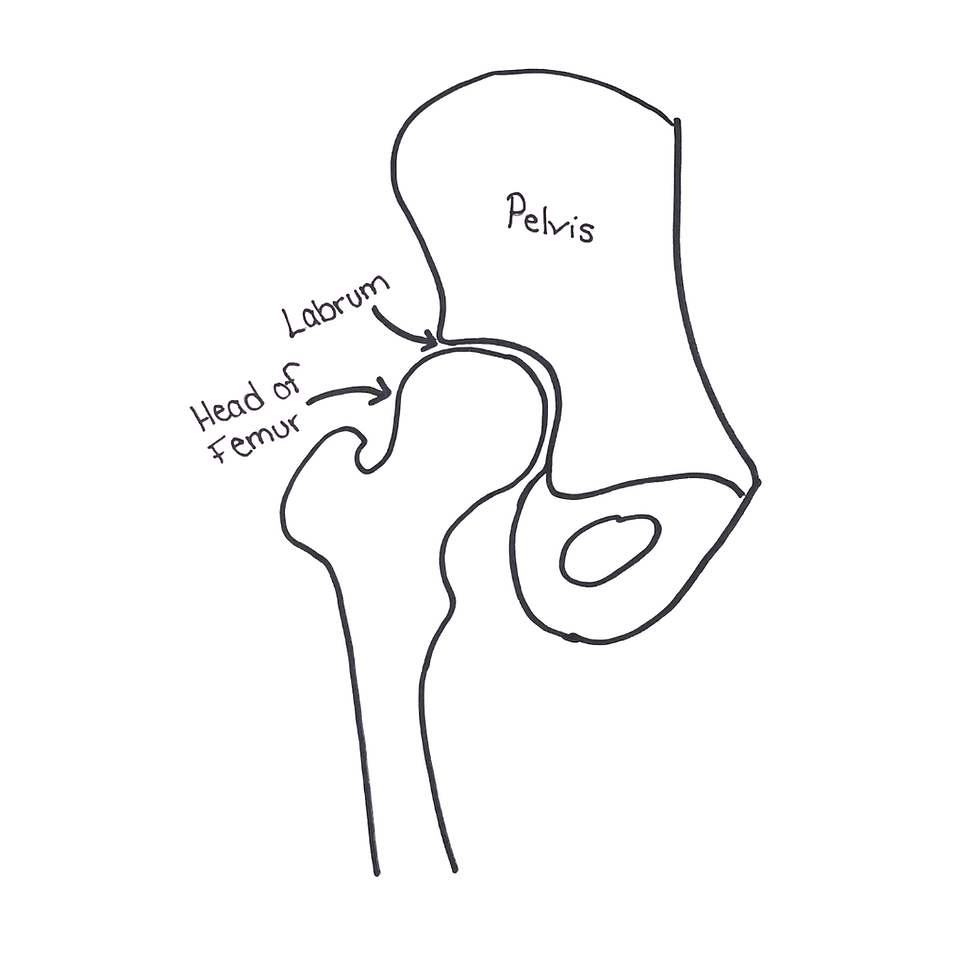
Yes, the surgery addresses the structural component of the problem. So your surgeons will reshape bone, address impingement, or repair the labrum itself…
But hip pain is rarely just structural.
Very often, it’s a combination of things like structural factors, movement mechanics and neuromuscular coordination
And surgery only addresses one of those pieces.
If the way your hip moves hasn’t changed, the joint may still experience the same stress patterns that caused the pain in the first place.
Here’s an interesting stat to back this up…
Research shows that 60–70% of people with no hip pain at all have structural findings like labral tears or impingement on MRI. That means thousands of people are walking around with the exact same structural issues, but are entirely pain free.
So the question becomes:
Is the structure really the root cause of your symptoms?
Sometimes it is. But many times, it’s actually how the hip is moving that creates more of the problem.
For example, someone might experience pinching when lifting their leg to put on pants or climb stairs. But when they move the hip differently—say in a supported position like hands-and-knees—the same motion becomes pain-free.
That tells us something important. It tells us that the hip joint is capable of moving through the full range without restriction. So in standing, the issue isn’t the structure blocking the movement…it’s the mechanics of how the body coordinates it.
If those mechanics aren’t addressed before or after surgery, the pain remains unchanged.
Reason #2: Generic Physical Therapy Without a Clear Strategy
The second major reason people experience pain after labral tear surgery is that their rehab program lacked a clear, strategic progression.
Many people go to physical therapy after surgery, but their experience looks something like this:
A few exercises are prescribed (probably a million bridges, clams or banded side steps…) and you do them 3x/wk for 12 weeks while a tech watches you from the other side of the room….
Sound familiar?
Yeah… that’s not effective PT for labral tears (or anything else for that matter).
Good rehab isn’t just about doing exercises. It’s about how your body moves.
Strength absolutely matters— your hip needs strong muscles to support the joint— but if your movement patterns keep putting the hip into positions that irritate the labrum, strengthening alone won’t solve the problem.
That’s why our rehab framework focuses on 4 key phases:
Calm the symptoms
Optimize movement patterns
Rebuild strength
Elevate performance
In that order. Always.
There has to be strategy behind your rehab, and without it, you are left guessing and still in pain.
Reason #3: Your Nervous System Is Still Protecting the Hip
The third reason people continue to experience pain after labral tear surgery has to do with the nervous system.
If you’ve been dealing with hip pain for months or years, your brain and nervous system have likely learned to protect the joint.
This protection often shows up as muscle guarding, excessive tension around the joint, compensating or fear around movement.
And it’s because your brain’s goal is simple:
Avoid pain.
So it changes how your body moves to prevent feeling pain. Except here’s the problem:
Those patterns that were once protective, eventually become problematic.
Your brain may still interpret certain movements—like squatting or bending—as dangerous. So the muscles tense up, movement becomes guarded and pain continues. Even if there is no longer a reason for your body to protect that way, your nervous system hasn’t learned any different yet.
In some cases, this nervous system protection even creates more discomfort than the original injury itself.
That’s why part of recovery must involve retraining the nervous system.
Simple strategies like:
Diaphragmatic breathing
Gradual exposure to movement
Building confidence in smaller ranges of motion before bigger ones…
It all helps restore trust between the brain and the body.
Every pain-free movement is like depositing a coin into a “trust bank.” Over time, the nervous system learns:
“This movement is safe again.”
And that’s when real recovery can start.
If You’re Still Experiencing Pain After Labral Repair Surgery
If you’re reading this I assume it’s because you’re still dealing with pain after surgery to fix your labral tears, so I want you to hear this clearly:
You’re not broken.
You’re not a lost cause.
And your surgery didn’t fail.
You just need to pay attention to the missing pieces.
Once those pieces are addressed, many people finally start seeing progress—even years after surgery.
The Next Step: Get a Clear Plan
If you’re feeling stuck and unsure what to do next, the best thing you can do is get clarity.
That’s exactly why we offer Discovery Calls.
During this call, we’ll talk through your surgery and recovery history, the symptoms you’re still experiencing, and trying to figure out the missing pieces in your rehab.
From there, we’ll outline a clear strategy forward. Because once you understand what’s actually driving your pain, the path to recovery becomes much clearer.
Apply for a Discovery Call here and let’s start figuring out what your hip really needs.
You don’t have to stay stuck in this cycle—and you definitely don’t have to figure it out alone.


Comments